Paella is the dish most people think of first when you mention Spanish food. It shows up in tourist restaurants across Spain, on menus from London to Los Angeles, and at summer barbecues wherever someone has a wide pan and a bag of rice.
But the version most people know, a mix of seafood, chicken, and bright yellow rice, is very different from what paella actually was, and in many ways still is, in its home region of Valencia.
The true history of paella is a story about farming communities, open fires, and the kind of cooking that emerges when resourceful people make something extraordinary from what’s available around them.
Where Paella Comes From
Paella was born in the wetlands and rice paddies surrounding the city of Valencia, on Spain’s eastern coast.
The area around the Albufera lagoon, just south of Valencia, has been growing rice since the Moors introduced it to the Iberian Peninsula around the 10th century. That rice culture became central to Valencian life and, eventually, to Valencian cooking.
The dish we now call paella most likely emerged somewhere in the late 18th or early 19th century. Farm workers cooking outdoors over an open fire, using a wide, flat pan, would make rice with whatever they had close at hand: rabbit, chicken, snails, green beans, and tomatoes from the fields nearby.
The wide, flat pan itself is also called “paella,” and many food historians argue that this is where the dish gets its name, from the vessel rather than the ingredients. The word paella comes from the Latin “patella,” meaning pan.
The Original Paella Valenciana
Paella Valenciana, the original and most traditional form of the dish, would surprise many people who’ve only ever eaten the tourist version.
There is no seafood. There is no chorizo. There are no peas.
Authentic Paella Valenciana contains chicken, rabbit, ferraura (a flat green bean), garrofó (a large white bean), tomato, olive oil, saffron, and water. Some recipes include snails, and many Valencian cooks consider snails essential. A sprig of rosemary is sometimes added near the end.
That’s it. The dish is disciplined and specific, and Valencians feel strongly about it. The local regulatory body, the Denominación de Origen Arroz de Valencia, has even attempted to define which ingredients are acceptable in a “true” paella, a move that generated fierce debate among chefs and home cooks alike.
The key element that makes paella paella, as opposed to any other rice dish, is the socarrat: the thin, slightly caramelised crust of rice that forms on the bottom of the pan in the final minutes of cooking. Achieving a good socarrat is a matter of heat control, timing, and experience. It’s what separates a good paella from a great one.
How Paella Spread Beyond Valencia
For most of its history, paella was regional food, made in Valencia and largely unknown outside it.
That began to change in the mid-20th century as Spain opened up to international tourism. Visitors arriving on Spain’s Mediterranean coast wanted to eat local food, and paella was the most visually striking and shareable dish available. Restaurants catering to tourists began adapting the recipe to suit broader tastes, adding seafood, chorizo, and extra colour.
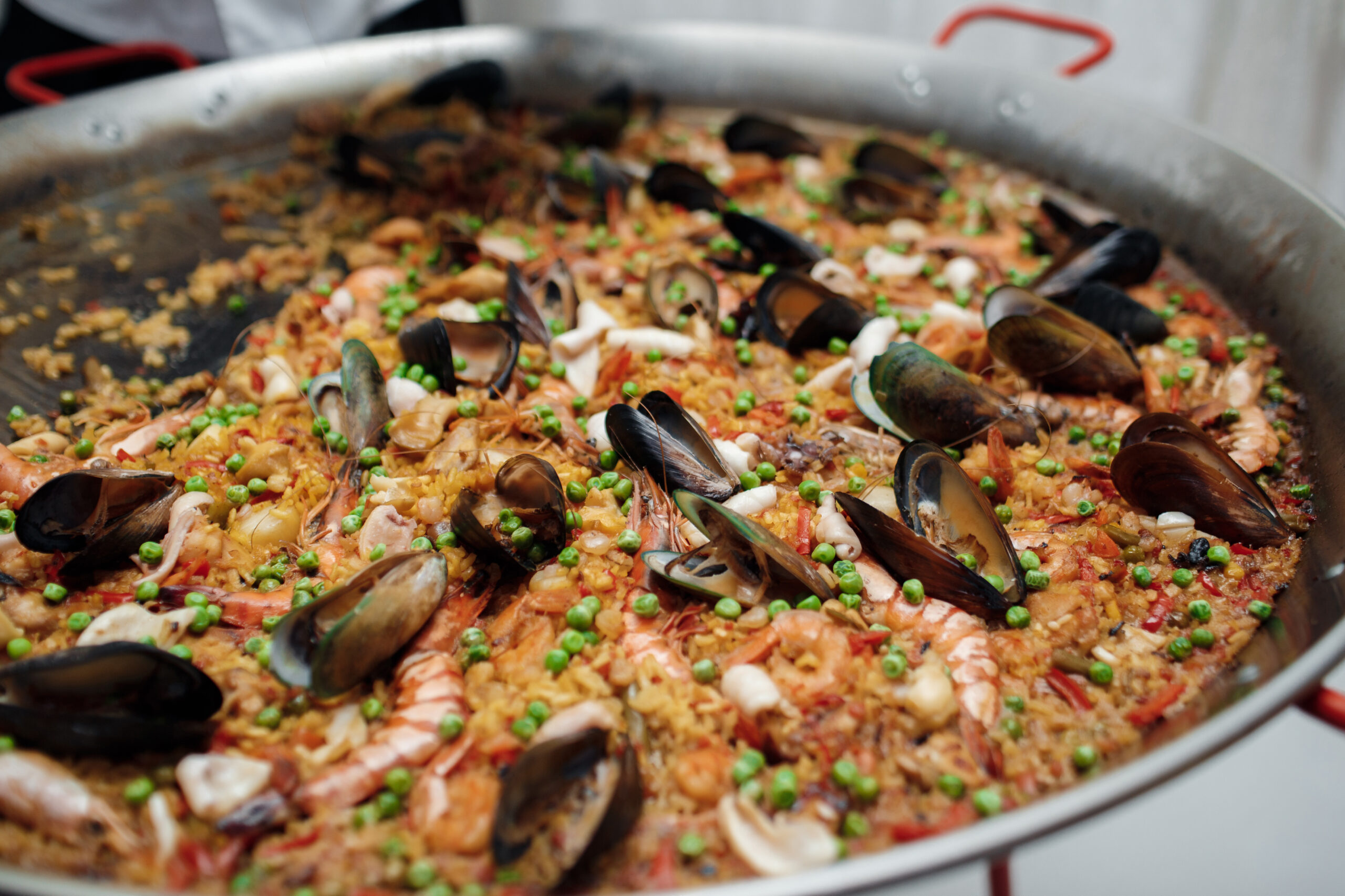
By the 1960s and 1970s, a hybrid version of paella, mixing chicken, shellfish, and rice coloured bright yellow with saffron or, more commonly, cheap food dye, had become the face of Spanish cuisine abroad.
This version spread to Spanish restaurants internationally, became a fixture of holiday menus across the Mediterranean, and eventually solidified in the global imagination as “Spanish paella.” Valencians, for the most part, do not consider it paella at all.
The Seafood Paella Debate
The division between Paella Valenciana and seafood rice dishes is a genuine fault line in Spanish food culture.
What most people call “seafood paella” is more accurately described in Spanish as “arroz con mariscos” (rice with shellfish) or, in some regions, “paella de marisco.” Purists argue the seafood version shouldn’t use the paella name at all.
The argument isn’t purely semantic. In the Valencian tradition, the stock used to cook the rice is made from the meat and bones of the chicken and rabbit in the pan. Seafood paella uses a different base, usually a shellfish stock, which changes both the flavour profile and the cooking method significantly.
That said, seafood rice dishes cooked in a paella pan are delicious in their own right. Arroz negro, rice cooked in squid ink with cuttlefish and alioli, is one of the most striking dishes in Spanish cuisine. Arroz caldoso, a soupy rice with lobster, is beloved all along the Catalan and Valencian coast.
None of these are Paella Valenciana. All of them are worth eating.
Paella Outside Spain
Paella has now become a global dish, adapted to local ingredients and tastes on every continent.
In Latin America, versions using local seafood and spices are common. In the Philippines, which spent centuries as a Spanish colony, rice dishes with clear paella DNA appear in regional cooking. In the United States, paella has become a popular dish for outdoor cooking enthusiasts, often made in large pans over propane burners at tailgate parties and family gatherings.
Each adaptation is a measure of how far the dish has travelled from the Albufera lagoon, but also of how adaptable rice cooking is as a format. The wide pan, the single-layer rice, the evaporation method rather than absorption, and the ideal of socarrat: these elements translate across cultures even when the ingredients change entirely.
How to Think About Paella Today
The best way to approach paella, especially if you’re new to Spanish food, is to separate it into categories.
First, there is Paella Valenciana: the original, the strictest, the one with rabbit, chicken, beans, and snails, made in Valencia or by Valencians who learned from family tradition. If you ever have the chance to eat this version cooked correctly over a wood fire, take it without hesitation.
Second, there are the regional Spanish rice dishes that use a paella pan but follow their own traditions: arroz negro, arroz a banda (rice cooked in a rich fish stock and served separately from the fish), and the various arroz con mariscos preparations found along the Spanish coast. These deserve respect on their own terms.
Third, there is international paella: adapted, often simplified, and sometimes unrecognisable from the source. This version can still be excellent if the cook understands the fundamentals.
What connects all of them is rice, good stock, a wide flat pan, and the patience to let the heat do its work.
A Dish Built to Last
Paella has survived centuries of adaptation, argument, and imitation because its foundations are solid.
It’s a dish built on technique, not complexity. It rewards attention and punishes shortcuts. It turns modest ingredients into something much greater than their sum.
That’s why it became Spain’s most famous dish. Not because of marketing or tourism, but because when it’s made well, it’s one of the most satisfying things you can eat.